Transforming real estate with 3D scanning
The real estate industry is rapidly evolving, and technology is playing a key role in improving efficiency, accuracy and decision-making. One of the most transformative innovations? 3D scanning. By capturing precise digital measurements of properties, it is revolutionizing how real estate professionals assess, document and market buildings.
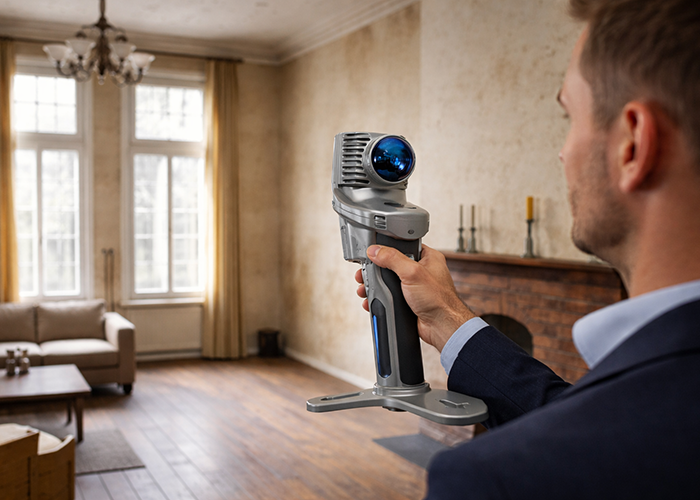
Whether for property appraisals, renovations or transactions, 3D scanning eliminates uncertainty when architectural plans are missing or outdated. With new advancements like SLAM (Simultaneous Localization and Mapping) scanners, real estate professionals can quickly and affordably map entire properties with high precision—without relying on manual measurements.
The role of 3D scanning in real estate

1. Generating accurate property measurements & floor plans
In real estate, knowing the exact dimensions of a property is crucial. Missing or inaccurate architectural plans can lead to costly miscalculations, delayed projects and uncertainty for buyers and investors. 3D scanning provides a fast and reliable solution:
- Capture precise measurements of every room, hallway and structure within minutes.
- Create highly accurate digital floor plans without manual measurements.
- Maintain consistent property records across multiple listings and transactions.
With SLAM technology, professionals can scan entire properties on-site with a handheld device, reducing costs compared to traditional laser scanning methods.

2. Faster, more reliable property documentation
Many properties lack updated architectural plans, making renovations, valuations and legal documentation challenging. 3D scanning fills this gap by creating an accurate digital model of any building, ensuring:
- Faster property assessments for real estate transactions and renovations.
- Accurate data for appraisals, permitting and insurance evaluations.
- A reliable reference for future modifications or expansions.
Instead of relying on outdated blueprints or estimates, real estate professionals can scan a building in real-time and instantly access trustworthy spatial data.

3. Enhancing real estate sales & marketing
Accurate measurements are just as important for selling and marketing a property. 3D scanning helps agents provide transparent, data-driven listings that build trust with potential buyers. Benefits include:
- Precise square meters, calculations, eliminating disputes over property size.
- Detailed property layouts, allowing buyers to assess room dimensions before visiting.
- Stronger client confidence, knowing that measurements are exact and verified.
Instead of relying on guesswork or outdated floor plans, buyers and investors get clear, reliable property information that speeds up decision-making.


Challenges and future trends
Despite its advantages, 3D scanning adoption in real estate has been slow due to cost and technical barriers. High-end scanning systems once required significant investments, but the rise of SLAM-based handheld scanners is reducing costs and making scanning more accessible.
Looking ahead, key trends include:
- Affordable SLAM scanners, making precise property scanning cost-effective.
- Automated data processing: integration, improved workflows
- Standardized digital property records, improving real estate documentation and transactions.
As technology evolves, 3D scanning is becoming an essential tool in real estate, ensuring that professionals have the exact data they need—when they need it.
Conclusion
3D scanning is changing the real estate industry by providing fast, accurate property measurements where blueprints are missing or unreliable. With SLAM scanners lowering costs, real estate professionals can quickly capture precise dimensions, create digital floor plans, and enhance property documentation.
Whether for sales, renovations, appraisals, or legal records, 3D scanning delivers trustworthy, data-driven solutions that streamline processes and improve decision-making.
Ready to bring accuracy and efficiency to real estate? Explore 3D scanning today!
Take 3D scanning to the next level with Pointorama
3D scanning is transforming real estate and interior design in ways many never imagined. But capturing data is just the first step—the real challenge is processing and using it effectively. That’s where Pointorama makes the difference.
With smart tools to clean, structure, and collaborate on point cloud data, Pointorama helps turn raw scans into actionable insights—fast and efficiently.
🚀 Curious to see it in action? Try Pointorama today!
Start your free trial See the product featuresRelated articles

GEO Business 2026 recap: Why our latest Pointorama release turned heads
At GEO Business 2026, Pointorama showcased its latest release, demonstrating how professionals can transform point clouds into accurate floor plans, measurements and deliverables within a single platform. Discover the new features, the industry’s biggest challenges, and how AI-powered automation is helping teams work faster and more efficiently.
Stronger together: how partnerships drive innovation at Pointorama
Partnerships are the driving force behind innovation at Pointorama. By connecting hardware, software and expertise, we transform raw scan data into structured, usable results through seamless workflows.
Pointorama on tour: meet us at key events in 2026
Meet Pointorama at key events in 2026. Discover new features, explore innovations and connect with our team across Europe.In 2026, Pointorama will be present at leading geospatial events across Europe, including GeoBusiness, Intergeo and Trefdag Digitaal Vlaanderen. Discover our latest innovations, explore new workflows and experience how much our technology has evolved when you meet us in person.