Photogrammetry vs. LiDAR for aerial surveying: a comprehensive comparison
Aerial surveying is essential for industries such as construction, urban planning, forestry and environmental monitoring. Two of the most widely used technologies for generating accurate 3D models and mapping data are photogrammetry and LiDAR (Light Detection and Ranging). Each has unique strengths and weaknesses and choosing the right one depends on project requirements, budget and accuracy needs.
In this article, we will explore what each technology is, compare their pros and cons and help you determine the best option for your aerial surveying needs.
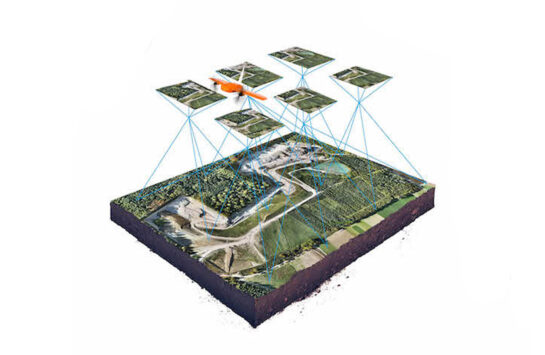
What is photogrammetry?
Photogrammetry is a technique that uses overlapping 2D images to reconstruct 3D models. The process involves:
- Capturing images from drones or aircraft using high-resolution cameras.
- Applying triangulation algorithms to create 3D models.
- Stitching images together using specialized software to generate accurate maps.
Equipment & software
- Hardware: Drones or aircraft equipped with RGB or multispectral cameras.
- Software: CAD tools, BIM tools, cloud-based tools
Common applications
- Construction site monitoring
- Real estate and urban mapping
- Terrain monitoring
- Agriculture and crop analysis
- Disaster response and damage assessment
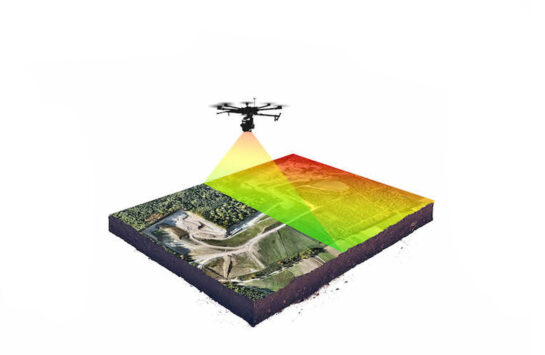
What is LiDAR?
LiDAR (Light Detection and Ranging) is an active remote sensing technology that emits laser pulses to measure distances and generate highly accurate 3D point clouds. Unlike photogrammetry, which relies on visible light, LiDAR can penetrate vegetation and function in low-light conditions.
Equipment & software
- Hardware: LiDAR sensors mounted on drones, aircraft, or terrestrial vehicles.
- Software: CAD tools, BIM tools, cloud-based tools
Common applications
- Forestry and vegetation analysis
- Infrastructure inspection (power lines, roads, bridges)
- Flood modeling and topographic mapping
Comparison: pros and cons
| Feature | Photogrammetry | LiDAR |
| Accuracy | Lower (depends on lighting & textures) | Higher (independent of light conditions) |
| Cost | More affordable (uses cameras) | Expensive (specialized sensors) |
| Data density | Less dense, depends on image quality | High-density point clouds |
| Processing time | Longer, requires image stitching | Faster, direct point cloud generation |
| Performance in vegetation | Poor (struggles with dense foliage) | Excellent (penetrates vegetation) |
| Equipment size | Lighter (uses standard drones) | Heavier (requires LiDAR sensors) |
Pricing considerations
Photogrammetry requires a lower initial investment, with costs primarily associated with drone hardware and software processing. This makes it an ideal choice for budget-conscious projects that still require detailed spatial data.
In contrast, LiDAR technology comes with a significantly higher upfront cost, ranging from €10,000 to well over €100,000 due to the expense of the sensors. However, LiDAR offers superior precision and efficiency, making it the preferred option for large-scale projects where accuracy and data density are critical.

Choosing the right technology
Choosing between Photogrammetry and LiDAR depends on your project’s needs, budget, and environmental conditions.
Photogrammetry is the better option if you need high-resolution color imagery and a cost-effective mapping solution. It works best in areas with clear visibility and minimal vegetation, where detailed surface textures are important. If your budget is limited and you can accommodate longer processing times, photogrammetry offers a practical and affordable approach.
LiDAR, on the other hand, is the preferred choice for projects that require high accuracy and detail, especially in environments with dense vegetation where photogrammetry struggles. It is ideal for topographic mapping, forestry assessments, and infrastructure scanning, providing precise elevation data even through tree canopies. If your project demands faster processing times and you have the budget for advanced equipment, LiDAR delivers superior results.
Conclusion
Both photogrammetry and LiDAR offer powerful solutions for aerial surveying, each excelling in different scenarios. While photogrammetry is more affordable and sufficient for general 3D modeling, LiDAR provides unmatched precision, especially in complex terrains. For many projects, a hybrid approach combining both technologies can offer the best results.
As technology evolves, we are likely to see more accessible and integrated solutions that merge photogrammetry and LiDAR for even greater accuracy and efficiency in aerial mapping.
Need help choosing the right surveying method for your project? Contact us today for expert guidance!
Get guidance Read the product featuresRelated articles
Stronger together: how partnerships drive innovation at Pointorama
Partnerships are the driving force behind innovation at Pointorama. By connecting hardware, software and expertise, we transform raw scan data into structured, usable results through seamless workflows.
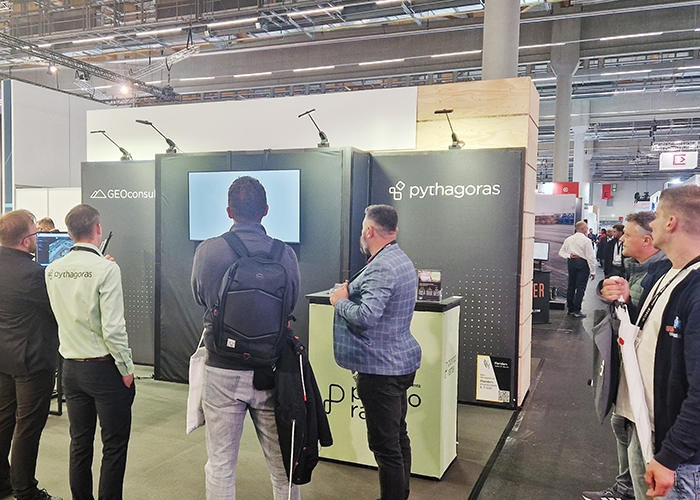
Pointorama on tour: meet us at key events in 2026
Meet Pointorama at key events in 2026. Discover new features, explore innovations and connect with our team across Europe.In 2026, Pointorama will be present at leading geospatial events across Europe, including GeoBusiness, Intergeo and Trefdag Digitaal Vlaanderen. Discover our latest innovations, explore new workflows and experience how much our technology has evolved when you meet us in person.

Indoor mapping and its role in modern surveying and construction
Indoor mapping has become a foundational technology for surveying and construction workflows involving existing buildings. By capturing interior environments as scan-based geometry, indoor mapping provides a reliable spatial reference that can be reused across applications such as floor plan generation, renovation and retrofit projects, scan-to-BIM workflows, real estate documentation and facility management.